Saturday, June 27, 2026
Home Blog Page 13

Sanjay Malhotra Appointed as RBI Governor, Succeeding Shaktikanta Das

0

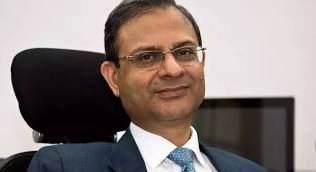
On December 9, 2024, the Indian government announced the appointment of Sanjay Malhotra as the new Governor of the Reserve Bank of India (RBI). Malhotra, currently serving as Revenue Secretary and a 1990-batch IAS officer from Rajasthan, will officially assume the role on December 11, 2024, succeeding Shaktikanta Das, whose tenure ends on December 10. Malhotra’s term will span three years, marking the beginning of a significant chapter for India’s central bank.

Challenges and Expectations for Malhotra

Malhotra’s appointment comes at a crucial time as the RBI navigates a complex economic landscape. The primary challenges include managing inflation, supporting economic growth, and addressing global economic uncertainties. Analysts are closely watching how Malhotra will steer monetary policy, particularly in light of speculation about potential interest rate cuts.

The February 2025 Monetary Policy Committee (MPC) meeting is expected to set the tone for his leadership, with market participants anticipating a shift toward a more accommodative stance. Factors such as a slowdown in economic growth and fluctuating inflation rates may prompt the MPC to initiate a rate-cutting cycle, according to some brokerages.

A Seasoned Administrator with a Strategic Role

Malhotra’s extensive experience in financial administration and public policy is expected to influence his approach as RBI Governor. His tenure as Revenue Secretary demonstrated his expertise in fiscal management and policy implementation, which will be instrumental in addressing the dual goals of economic stability and growth.

Under Malhotra’s leadership, the RBI is also expected to continue fostering innovation in financial services, advancing digital payments, and supporting India’s push for global economic prominence.

Shaktikanta Das’s Legacy

Shaktikanta Das’s term as RBI Governor saw significant milestones, including the handling of pandemic-induced economic disruptions, management of inflationary pressures, and promotion of financial inclusion. His tenure also underscored the importance of communication and coordination between fiscal and monetary authorities. Malhotra’s appointment marks a continuation of this critical leadership, with new challenges awaiting innovative solutions.

Market Reactions and Forward Outlook

Financial markets are keenly observing this transition, as the RBI’s monetary policy decisions significantly impact India’s economic trajectory. Malhotra’s leadership style, coupled with changes in the MPC’s composition, could shape market sentiment and investor confidence in the coming months.

As the new Governor prepares to take office, stakeholders across the financial and policy spectrum await his vision for steering India’s economy through evolving challenges and opportunities.

Former Karnataka Chief Minister S. M. Krishna Passes Away at 92

0

S. M. Krishna, a veteran politician and former Chief Minister of Karnataka, passed away at the age of 92 in Bengaluru on December 10, 2024, following a prolonged illness. Krishna breathed his last at his residence at 2:45 AM, with his family announcing that his final rites would take place in Maddur, his hometown.

A Distinguished Career Spanning Six Decades

Born on May 1, 1932, in Somanahalli, Karnataka, S. M. Krishna’s political journey began in the 1960s. A stalwart of Indian politics, he served in various key roles, including Chief Minister of Karnataka (1999–2004), Governor of Maharashtra (2004–2008), and External Affairs Minister of India (2009–2012).

As Chief Minister, Krishna played a pivotal role in transforming Bengaluru into the “Silicon Valley of India,” fostering the city’s IT sector and global prominence. His governance introduced several forward-thinking policies that attracted multinational corporations and nurtured startups, laying the foundation for the city’s thriving tech ecosystem.

Krishna’s contributions extended to Indian diplomacy as the External Affairs Minister, where he focused on strengthening India’s global partnerships and addressing critical foreign policy challenges.

In recognition of his exceptional service, Krishna was awarded the Padma Vibhushan in 2023, one of India’s highest civilian honors.

From Congress to BJP

After a long association with the Indian National Congress, S. M. Krishna joined the Bharatiya Janata Party (BJP) in 2017. His transition marked a significant shift in Karnataka’s political landscape, and he continued to influence state and national politics even in his later years.

Tributes Pour In

Leaders across party lines mourned Krishna’s demise, emphasizing his legacy as a visionary leader and statesman. Karnataka Chief Minister Siddaramaiah described him as a guiding force for the state’s development, acknowledging his remarkable contributions to Karnataka’s growth. Minister Priyank Kharge noted Krishna’s enduring vision for Bengaluru’s global stature, while BJP leaders praised his role in advancing Indian politics and governance.

Legacy of Leadership and Vision

S. M. Krishna’s impact on Karnataka and India is indelible. As a leader who championed modernization, economic growth, and technological advancement, his policies have left a lasting mark. The people of Karnataka and beyond remember him as a trailblazer who envisioned progress and inclusivity, shaping the state’s identity on the global stage.

With his passing, India bids farewell to a statesman whose vision and leadership enriched the nation. The void left by S. M. Krishna will be deeply felt in Indian politics and public life.

India-Bahrain High Joint Commission Meeting Highlights Strong Bilateral Ties

0

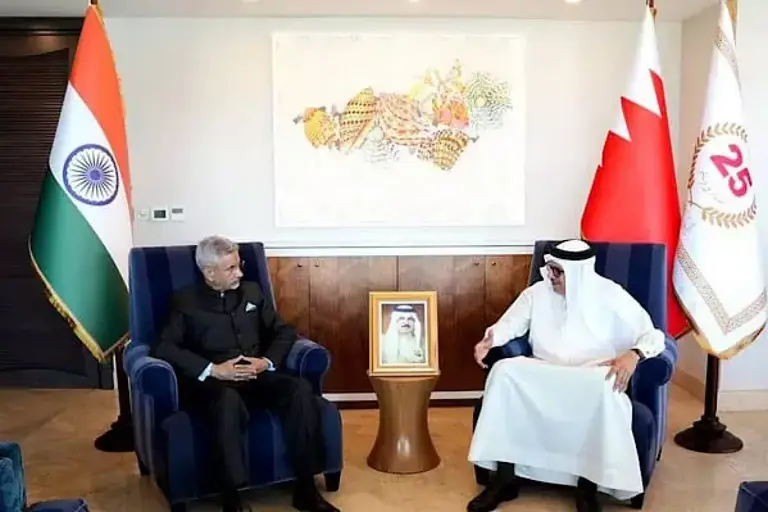
On December 9, 2024, the Fourth India-Bahrain High Joint Commission (HJC) meeting convened in Manama, co-chaired by India’s External Affairs Minister S. Jaishankar and Bahrain’s Foreign Minister Abdullatif bin Rashid Alzayani. This meeting underscored the two nations’ commitment to enhancing bilateral cooperation across diverse fields, focusing on economic growth, cultural ties, and security collaboration.

Strengthening People-to-People Ties and Bilateral Relations

The meeting highlighted the strong bond between India and Bahrain, underscored by a significant Indian diaspora of around 340,000 people, constituting nearly 25% of Bahrain’s population. This diaspora has played a pivotal role in fostering cultural and economic connections between the two nations. Indian investments in Bahrain and active bilateral cooperation in multiple sectors were acknowledged as key contributors to their growing partnership.

Economic Cooperation: Trade and Investment

Discussions on economic cooperation centered on bolstering trade and investment ties. The establishment of a Joint Working Group on Trade and Investment was a key outcome, aimed at identifying areas of mutual interest. Progress on the Bilateral Investment Treaty and efforts to eliminate double taxation were also discussed, with both sides expressing optimism about their completion. These initiatives aim to strengthen financial and industrial collaboration, benefitting businesses and workers in both countries.

Commitment to Combatting Terrorism and Enhancing Security

A strong commitment to combatting terrorism featured prominently in the agenda. Both nations reiterated their condemnation of terrorism in all forms and called for expedited security dialogues and cooperation mechanisms. The discussions also included cybersecurity collaboration, reflecting the shared goal of addressing emerging security challenges in the digital realm.

Cultural Connections and Historical Ties

India and Bahrain emphasized the importance of cultural exchanges to promote mutual understanding and strengthen their historical ties. Ongoing cultural initiatives were praised, including efforts to celebrate shared heritage and values. Such exchanges aim to deepen the people-to-people bonds that have long been a cornerstone of the bilateral relationship.

Broader Implications

The Fourth India-Bahrain HJC meeting reaffirms the robust and dynamic relationship between the two nations. With shared priorities in economic development, counter-terrorism, and cultural collaboration, the partnership continues to grow in strategic importance. The meeting’s outcomes reflect a vision of mutual prosperity and enhanced regional security, ensuring a strong foundation for future cooperation.

By prioritizing economic ties, cultural unity, and security collaboration, the India-Bahrain partnership stands as a model of enduring bilateral relations in an increasingly interconnected world.

Mamata Banerjee Responds Strongly to Bangladeshi Claims Over Indian Territories

0

West Bengal Chief Minister Mamata Banerjee has strongly addressed provocative statements made by a Bangladeshi politician from the Bangladesh Nationalist Party (BNP) claiming territorial rights over Indian states Bengal, Bihar, and Odisha. Speaking in the West Bengal Assembly on December 9, 2024, Banerjee firmly rejected these remarks, questioning if Indians would tolerate foreign forces occupying their lands. In her speech, she sarcastically asked whether Indians would accept such a situation with a “lollipop,” highlighting the absurdity of the claims.

The Provocation and Mamata Banerjee’s Reaction

The controversy arose after a BNP leader in Bangladesh made comments asserting that Bangladesh had historical claims over parts of India. These remarks quickly sparked outrage, particularly in West Bengal, where Banerjee took the opportunity to assure the public that the state government would not allow such claims to disrupt the harmony and sovereignty of India.

Banerjee called on the people of Bengal to remain calm and refrain from reacting impulsively to the provocative statements. She stressed the importance of maintaining peace and unity among the diverse communities in the state. Banerjee also reminded citizens that the Indian government is responsible for handling diplomatic matters and reassured them of her administration’s support for any decisions made by the central government.

A Call for Restraint and Responsible Media Coverage

In her address, Banerjee emphasized the need for responsible reporting by the media to prevent unnecessary escalation of tensions. She urged political parties and citizens to act with restraint and avoid actions that could lead to communal discord. Banerjee highlighted the importance of prioritizing national integrity over political agendas during such sensitive situations.

Imams and Community Leaders Condemn Provocative Remarks

Banerjee’s speech also acknowledged the role of religious and community leaders in maintaining harmony in West Bengal. She noted that several imams in the state have openly condemned the remarks from the Bangladeshi leader. These leaders also expressed concern over the recent violence against minorities in Bangladesh, underscoring the need for mutual respect and peace between communities on both sides of the border.

The chief minister praised these efforts and urged all leaders, irrespective of their political or religious affiliations, to work toward strengthening unity in West Bengal. She pointed out that her government has consistently prioritized communal harmony and will continue to take steps to ensure peaceful coexistence.

Historical Context of the Claims

The Bangladeshi leader’s remarks are not the first time such claims have been made. Historical tensions between India and Bangladesh over territorial and cultural issues date back to the partition of Bengal in 1947 and the subsequent independence of Bangladesh in 1971. These claims, however, have no legal or historical basis in modern geopolitics and are often dismissed as rhetoric intended to stoke nationalist sentiment.

India and Bangladesh share a strong relationship, particularly under the leadership of Sheikh Hasina, the current Prime Minister of Bangladesh. However, provocative statements from opposition leaders in Bangladesh sometimes test this relationship, prompting diplomatic responses from India.

Diplomatic and Political Responses

The Indian government has not yet issued an official response to the BNP leader’s statements, but the Ministry of External Affairs (MEA) is likely to address the issue through diplomatic channels. Banerjee affirmed that her party, the Trinamool Congress (TMC), will fully adhere to any guidelines or measures outlined by the MEA.

Meanwhile, political parties across India have expressed varying reactions to the controversy. While opposition parties in West Bengal have criticized the TMC for not taking a stronger stance, Banerjee’s supporters argue that her emphasis on calm and unity is the most constructive approach.

Public and Media Reactions

The provocative claims and Banerjee’s response have generated significant media coverage in West Bengal and beyond. News outlets have widely reported her fiery remarks, particularly her reference to the “lollipop” analogy, which has struck a chord with many Indians.

Public opinion, as reflected on social media platforms, has been mixed. While many have praised Banerjee for her decisive and patriotic stance, others have criticized the central and state governments for not taking more immediate and concrete action against the Bangladeshi leader’s remarks.

 A Unified Approach to Sovereignty

Mamata Banerjee’s speech in the West Bengal Assembly highlights her commitment to safeguarding India’s sovereignty and maintaining communal harmony in her state. By addressing the provocative remarks from Bangladesh with a blend of sarcasm and seriousness, she aimed to reassure her constituents while emphasizing the importance of a unified response.

As the situation develops, the focus will likely shift to how the Indian government handles the diplomatic fallout. Banerjee’s leadership during this period underscores her political acumen and her dedication to ensuring that West Bengal remains a model of peace and unity amid external provocations.

For now, the message from West Bengal is clear: India’s territorial integrity is non-negotiable, and any attempt to disrupt its peace will be met with firm resistance, guided by diplomacy and communal harmony.

Rahul Gandhi Stages Mock Interview Targeting Modi and Adani Amid Adani Controversy Protests

0

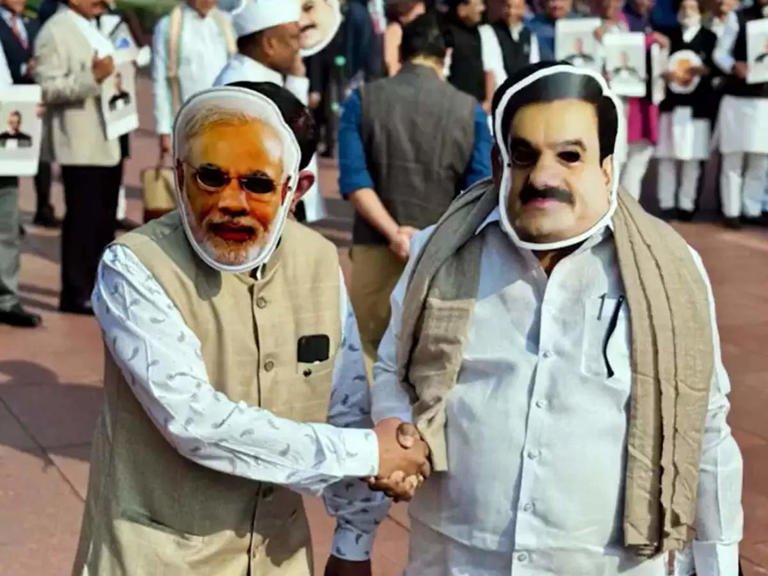
On December 9, 2024, Rahul Gandhi, a prominent Congress leader and a relentless critic of Prime Minister Narendra Modi, staged a unique protest outside the Indian Parliament. The event took the form of a satirical “mock interview,” targeting Modi and billionaire industrialist Gautam Adani, amidst fierce opposition protests over allegations of corruption and cronyism involving the Adani Group. This performance marks a significant moment in Indian politics, as opposition parties intensify their demand for accountability from the ruling BJP government.

The Mock Interview: A Political Satire

In a dramatic display, Gandhi set up a makeshift interview outside Parliament, with opposition MPs wearing masks symbolizing Modi and Adani. As Gandhi posed pointed questions, the masked figures responded with exaggerated camaraderie, claiming, “We do everything together. We have had a relationship for years.” The sarcastic tone underscored allegations of a close and questionable nexus between Modi’s government and Adani, a topic that has long been a point of contention for the opposition.

The performance was more than a theatrical act; it was a calculated political move aimed at drawing public attention to the opposition’s allegations. Through humor and satire, Gandhi sought to highlight what he calls a systematic undermining of democratic principles and an erosion of accountability in governance under Modi’s leadership.

Context of the Protests

The mock interview occurred amidst heightened tensions in Parliament, where the Lok Sabha has faced repeated disruptions due to opposition-led protests. These protests center on allegations of bribery involving the Adani Group in the United States, a controversy that has reignited debates about corporate influence in Indian politics.

The opposition has demanded a thorough parliamentary discussion on the issue and transparency regarding investigations into Adani’s financial dealings. They argue that the government’s reluctance to address these concerns reflects an attempt to shield powerful allies from scrutiny. For Gandhi, this mock interview was a way to amplify these demands, connecting with the public through a visually striking and memorable protest.

Rahul Gandhi’s Critique of Modi

Gandhi used the opportunity to reiterate his criticism of Modi, accusing him of avoiding parliamentary debates and accountability. He alleged that Modi’s close ties with Adani undermine democratic processes and allow unchecked corporate influence. Gandhi’s social media posts accompanying the event emphasized what he described as a “decades-old relationship” between Modi and Adani, framing the issue as a symptom of larger systemic corruption.

This critique aligns with Gandhi’s broader political strategy to position Congress as the defender of democratic values and public accountability. His focus on the Modi-Adani connection has become a cornerstone of his campaign to rally opposition forces and gain public support.

Political Reactions

The BJP swiftly dismissed Gandhi’s mock interview as a publicity stunt, accusing him of trivializing serious parliamentary proceedings. BJP leaders argued that such theatrics distract from substantive debates and undermine the dignity of Parliament. They reiterated that the allegations against Adani are baseless and politically motivated.

On the other hand, opposition leaders praised Gandhi’s boldness, describing the mock interview as a creative way to shed light on critical issues. They argue that traditional methods of protest often fail to capture public attention, and Gandhi’s approach effectively communicates their concerns to a wider audience.

Public Response and Media Coverage

The public’s reaction to Gandhi’s protest has been mixed. While some praised his innovative approach and commitment to challenging the status quo, others criticized it as mere political grandstanding. Social media platforms have been abuzz with debates, memes, and commentary, reflecting the polarizing nature of Gandhi’s actions.

Media coverage has also varied, with some outlets focusing on the substance of the allegations and others highlighting the performative aspect of the protest. The event has undoubtedly succeeded in reigniting conversations about corporate governance, political accountability, and the role of satire in political discourse.

The Broader Implications

Gandhi’s mock interview is emblematic of a larger shift in Indian political protest. In an era dominated by visual media and social networks, traditional methods of dissent often struggle to gain traction. By staging a dramatic and satirical protest, Gandhi not only captured headlines but also engaged a younger, media-savvy audience.

This protest also underscores the evolving relationship between opposition parties and the BJP-led government. The increasing use of innovative protest methods suggests a recognition among opposition leaders that they must adapt to the changing dynamics of political communication to remain relevant.

Rahul Gandhi’s mock interview outside Parliament was more than a political stunt; it was a strategic move to draw attention to pressing issues and challenge the government’s accountability. By blending humor with sharp critique, Gandhi demonstrated a willingness to innovate in his approach to opposition politics.

The event has added another layer to the ongoing debate about transparency, corporate influence, and the health of Indian democracy. As the controversy around Adani continues to unfold, Gandhi’s protest serves as a reminder of the power of satire and symbolism in shaping political narratives. Whether it translates into tangible political gains remains to be seen, but for now, it has firmly placed the Modi-Adani issue at the center of India’s political discourse.

“Embracing Versatility: Aanchal Munjal Talks About Her Role in Pushpa 2 and Her Journey in Cinema”

0

Aanchal Munjal, an emerging talent in Indian cinema, recently shared her excitement about being part of the highly anticipated Pushpa 2: The Rule. Playing the role of Hameed’s girlfriend, she praised director Sukumar’s creative vision and the opportunity to collaborate with seasoned actors like Allu Arjun.

Speaking about her career, Aanchal reflected on her evolution from a child actor to embracing mature and challenging roles. She expressed her desire to continue exploring diverse characters while staying true to her craft.

Aanchal emphasized her gratitude for the love from her fans and the lessons from every project. With a promising future and more projects in the pipeline, she’s keen to leave a lasting mark on the industry.

The actress concluded by sharing her belief in growth, perseverance, and staying authentic in the ever-evolving world of cinema.

“Aanchal Munjal Opens Up About Working in Pushpa 2 and Embracing Growth in Her Acting Career”

Afghan Women: Silenced, Banned, and Forgotten A Nation’s Half Abandoned

0

Since the Taliban’s return to power in August 2021, Afghanistan has undergone a profound transformation, with Afghan women bearing the brunt of regressive and oppressive policies. Systematically stripped of their rights, women are now excluded from education, work, healthcare, and virtually every facet of public life. These restrictions, enforced under the guise of cultural and religious norms, have far-reaching consequences that affect not only women but the entire fabric of Afghan society.

The situation has deteriorated further with the recent bans on women in healthcare—both as providers and recipients. Hospitals and medical training institutions, once a refuge for women seeking a better future, are now closed to them, pushing an already fragile healthcare system to the brink of collapse. This article delves into the lived realities of Afghan women under Taliban rule, examining the devastating consequences for individuals, families, and the nation.

The Healthcare Ban: A Death Sentence for Afghan Women

Restricted from Training and Care

On December 3, 2024, the Taliban formally banned women from studying nursing and midwifery in private medical institutions, shutting the door on one of the few remaining professions accessible to Afghan women. This directive follows earlier bans barring women from attending universities, effectively ensuring no future generation of female healthcare professionals.

This move has dire consequences in a country where cultural norms dictate that women can only be treated by female healthcare providers. For many Afghan women, this ban is a death sentence. Hospitals across the nation are already struggling to provide basic services due to a shortage of qualified female staff. With no new doctors, nurses, or midwives being trained, the healthcare system faces an imminent collapse.

Dr. Farah, a former midwife in Herat, expressed her despair:
“The Taliban have destroyed what little progress we made. Women will die in childbirth, infants will perish, and illnesses that could have been treated will become fatal because there’s no one to help.”

Maternal Mortality and Beyond

Afghanistan has long grappled with one of the highest maternal mortality rates in the world, with over 600 deaths per 100,000 live births. This figure is set to climb as access to prenatal, delivery, and postnatal care becomes increasingly scarce.

Leila, a young mother from Kandahar, shared her story:
“When I went into labor, there was no female doctor at the hospital. The male doctor refused to see me without my husband’s permission. By the time my husband arrived, it was too late for my baby.”

This tragic reality is becoming alarmingly common. For women in rural areas, the situation is even worse. Many must travel for hours, often without a male guardian, only to find that no female doctors are available to treat them.

Impact on the Healthcare System

The absence of female professionals is not only a crisis for women but for the healthcare system as a whole. Vaccination programs, maternal health initiatives, and child nutrition campaigns—all reliant on female staff—are now in jeopardy. The reversal of decades of progress in public health is becoming a grim reality, with far-reaching consequences for the nation’s health and well-being.

Life Under Taliban Rule: Education, Employment, and Freedom Denied

The Ban on Education

Education has been systematically stripped away from Afghan women and girls. The Taliban’s decision to prohibit girls from attending secondary schools means that most girls are denied formal education by the age of 12.

Private educational institutions, which once offered a lifeline, are now also closed to women. The ban on higher education has extinguished dreams of becoming doctors, teachers, or professionals, leaving a generation of women without prospects.

Fatima, a former university student, shared her heartbreak:
“We dreamed of a future where we could contribute to our country. Now, our dreams are ashes. The Taliban have taken everything from us.”

Erased from the Workforce

Women who once worked as teachers, doctors, journalists, and civil servants have been forced out of their jobs. The Taliban have decreed that women belong at home, dependent on their male relatives for support.

Zahra, a former journalist, now lives in hiding:
“I used to report on stories of hope and progress. Now, I am one of the stories of despair. We are invisible, forgotten by the world.”

Enforced Isolation

Beyond education and employment, women face restrictions on their mobility and personal freedoms. Women cannot travel alone or visit public spaces without a male guardian (mahram). Parks, gyms, and even women’s bathhouses have been declared off-limits.

This enforced isolation has created a mental health crisis among Afghan women. Depression, anxiety, and suicide rates are rising as women find themselves trapped in an oppressive and suffocating environment.

The Economic and Social Fallout

Economic Consequences

The exclusion of women from the workforce has devastated Afghanistan’s economy. Women once contributed significantly to household incomes, particularly in urban areas. With families now reliant on a single income, poverty is deepening.

The country’s GDP has contracted sharply, exacerbated by international sanctions and the withdrawal of foreign aid. Without the contributions of women, Afghanistan is losing a critical engine of economic growth.

A Fractured Society

The erasure of women from public life has created a fragmented society. Men, burdened as sole providers, face increased stress and pressure. Families are struggling to adapt to the loss of women’s roles as educators, caregivers, and breadwinners.

Social cohesion is eroding as communities become increasingly polarized and disconnected from the global progress in gender equality.


Resistance in the Shadows

Underground Schools

Despite the risks, Afghan women are defying the Taliban by organizing underground schools to educate girls in secret. These schools operate in private homes, often changing locations to avoid detection.

Teachers like Mariam risk their lives to keep the flame of knowledge alive:
“Education is a right, not a privilege. If we stop teaching, they will win. We cannot let that happen.”

Social Media and Advocacy

Afghan women are using social media to amplify their voices and share their stories with the world. Campaigns like #LetUsExist and #StandWithAfghanWomen are gaining traction, providing a platform for women to resist oppression and demand their rights.

Taiba, an activist, emphasized the importance of these platforms:
“They want to silence us, but we will not be silenced. Our voices will echo beyond Afghanistan.”

International Responsibility

A Global Duty

The international community has condemned the Taliban’s actions, but meaningful intervention has been limited. Humanitarian aid must prioritize Afghan women, ensuring access to healthcare, education, and safe spaces.

Diplomatic efforts should pressure the Taliban to reverse their oppressive policies, while asylum programs can provide refuge for women at immediate risk.

Rebuilding for the Future

Long-term solutions require rebuilding Afghanistan’s healthcare and education systems in ways that empower women. International organizations and governments must commit to sustained investment and advocacy for gender equality.

A Glimmer of Hope

Afghan women are not passive victims. They are resilient, courageous, and determined to fight for their rights. Their struggle is a testament to the strength of the human spirit in the face of unimaginable oppression.

Their story is a call to action for the world. Afghan women’s rights are human rights, and their fight is a fight for justice, equality, and dignity. The global community must stand with them, not just in words but in action, ensuring that their voices are heard and their rights restored.

Afghanistan’s future depends on it.

The Phenomenal Success of Pushpa 2: The Rule

0

The Indian film industry has witnessed a monumental achievement with the release of Pushpa 2: The Rule, the sequel to the blockbuster Pushpa: The Rise. Directed by Sukumar and starring Allu Arjun, the film has shattered box office records globally, establishing new benchmarks for Indian cinema. This article delves into the key milestones, underlying factors contributing to its massive success, and the broader implications of this cinematic triumph.

Unprecedented Pre-Sales Milestone

One of the most astonishing feats of Pushpa 2 was its ₹100 crore advance ticket sales prior to its global release on December 5, 2024. This achievement underscores the film’s immense anticipation among audiences. Pre-sales have historically been a barometer for audience enthusiasm, and this staggering figure is indicative of how deeply the Pushpa franchise resonates with the masses.

Comparatively, this record-setting pre-sales number eclipses earlier milestones set by films such as Pathaan and RRR, signaling a shift in the Indian audience’s preferences, with a pronounced inclination towards larger-than-life storytelling and South Indian cinema’s aesthetic appeal.

Historic Opening Day Earnings

On its debut, Pushpa 2 grossed ₹294 crore worldwide, surpassing RRR’s ₹223 crore to become the highest-grossing Indian film on its opening day. This meteoric start is a testament to the power of pre-release hype combined with effective marketing and Allu Arjun’s magnetic screen presence.

The breakdown of earnings reveals that domestic collections alone contributed a substantial ₹185 crore, highlighting the dominance of regional audiences, especially in Telugu-speaking states. Meanwhile, international markets such as the U.S., U.A.E., and Australia also played a pivotal role in elevating the film’s stature, underscoring the growing global appeal of Indian cinema.

Rapid Revenue Accumulation: A Two-Day Phenomenon

By the end of its second day, Pushpa 2 had amassed a jaw-dropping ₹400 crore globally, with ₹265 crore coming from India. This swift revenue accumulation demonstrates the unparalleled popularity of the franchise. The film’s day-two performance outshines other major releases, reflecting sustained audience interest even after the initial euphoria.

Such growth patterns are indicative of the film’s strong word-of-mouth promotion, driven by early audience reviews and critical acclaim. The diverse linguistic reach, supported by multi-language releases, has ensured that the film resonates with audiences across India and beyond.


Occupancy Rates: A Multilingual Triumph

The film’s occupancy rates paint a vivid picture of its cross-demographic appeal. On its second day:

  • Telugu occupancy reached 53%, showcasing the film’s stronghold in its native language.
  • Hindi recorded an impressive 51.65%, emphasizing its pan-Indian appeal.
  • Tamil saw 38.52%, demonstrating significant traction in the South Indian market beyond Telugu audiences.

The variation in occupancy rates reflects the regional dynamics of Indian cinema while underscoring Pushpa 2’s ability to transcend linguistic and cultural barriers. This cross-cultural acceptance is a noteworthy achievement, signaling the increasing homogenization of Indian cinema.


Critical Acclaim and Audience Reception

Reviews for Pushpa 2 have been overwhelmingly positive. Critics and audiences alike have praised the film for its:

  • Action Sequences: Choreographed with precision, the action scenes in Pushpa 2 have set new standards for the genre, combining raw energy with stylistic finesse.
  • Character Development: Allu Arjun’s portrayal of Pushpa Raj has been lauded for its depth and complexity, solidifying his position as one of Indian cinema’s most bankable stars.
  • Visual Grandeur: The cinematography and production design have created a visual spectacle, enhancing the storytelling.

These elements have not only elevated the sequel above its predecessor but have also raised the bar for Indian action dramas.

 Factors Behind Pushpa 2’s Success

1. Allu Arjun’s Star Power

Allu Arjun’s magnetic screen presence has been a cornerstone of Pushpa 2’s success. Following his National Award win for Pushpa: The Rise, Arjun’s fan base expanded significantly. His unique style and ability to connect emotionally with audiences have made him a pan-Indian icon.

2. Sukumar’s Visionary Direction

Director Sukumar has masterfully blended a gritty narrative with commercial elements, appealing to both cinephiles and mainstream audiences. His ability to retain the essence of the original while introducing fresh elements in the sequel has been instrumental.

3. Robust Marketing Strategy

The film’s promotional campaign deserves special mention. From teaser trailers that went viral to interactive campaigns on social media, the marketing strategy ensured sustained engagement with fans. The anticipation was further amplified by the release of captivating songs and Allu Arjun’s electrifying dance performances.

4. Music and Background Score

Devi Sri Prasad’s music has been a defining feature of the Pushpa franchise. The sequel’s soundtrack and background score have resonated deeply with audiences, becoming anthems in their own right and amplifying the emotional impact of key scenes.

5. South Indian Cinema’s Rising Influence

The success of Pushpa 2 underscores the growing dominance of South Indian cinema in the national and global landscape. Films like Baahubali, KGF, and RRR have paved the way, and Pushpa 2 continues this trend by combining regional authenticity with universal appeal.

Comparison with Predecessor and Industry Impact

Performance vs. Pushpa: The Rise

While Pushpa: The Rise was a resounding success, grossing over ₹350 crore globally during its entire theatrical run, Pushpa 2 achieved comparable numbers within its first two days. This exponential growth highlights how sequels, when executed well, can capitalize on the goodwill of their predecessors.

Setting New Benchmarks

The film’s achievements have set new benchmarks for the Indian film industry:

  • Highest pre-sales for an Indian film.
  • Record-breaking opening day and two-day collections.
  • Establishment of Allu Arjun as a pan-Indian superstar.

These milestones have redefined success parameters for Indian cinema, encouraging producers to invest in high-quality storytelling and innovative marketing.


Broader Implications

1. Strengthening South Indian Cinema’s Global Influence

The phenomenal success of Pushpa 2 underscores the increasing global clout of South Indian cinema. Its ability to cater to diverse audiences has not only enriched Indian cinema but has also challenged the long-standing dominance of Bollywood.

2. Elevation of Pan-Indian Films

The rise of pan-Indian films, characterized by multilingual releases and universal themes, is reshaping the industry. Pushpa 2 exemplifies this trend, proving that regional stories can achieve global recognition.

3. Inspiration for Future Projects

The record-breaking performance of Pushpa 2 is likely to inspire filmmakers to aim higher. This includes prioritizing scripts with universal appeal, investing in top-notch production values, and creating larger-than-life cinematic experiences.

Pushpa 2: The Rule is more than just a film; it is a cultural phenomenon that has redefined the Indian cinematic landscape. With its record-breaking pre-sales, historic opening day collections, and critical acclaim, the film has set new standards for what Indian cinema can achieve. As audiences continue to flock to theaters, Pushpa 2 not only reinforces the global appeal of South Indian cinema but also serves as a testament to the power of compelling storytelling and charismatic performances.

This resounding success is not merely a reflection of the franchise’s popularity but a harbinger of the transformative era Indian cinema is entering.

दिल्ली में बोनसाई और क्राइसेंथेमम महोत्सव का दूसरा संस्करण

0

नई दिल्ली, 1 दिसंबर 2024: दिल्ली पर्यटन ने शहरवासियों और पर्यटकों के लिए एक अनोखा अनुभव पेश करने का ऐलान किया है। दूसरा बोनसाई और क्राइसेंथेमम महोत्सव 6 दिसंबर से 8 दिसंबर 2024 तक गार्डन ऑफ फाइव सेंसेंस, साकेत मेट्रो स्टेशन के पास आयोजित किया जाएगा। यह तीन दिवसीय महोत्सव कला, प्रकृति और संस्कृति का अद्भुत संगम होगा, जिसमें हर उम्र के लोग भाग लेकर इस खास मौके का आनंद ले सकते हैं।

प्रकृति और कला का सुंदर मेल

इस महोत्सव का सबसे बड़ा आकर्षण बोनसाई प्रदर्शनी होगी, जिसमें कुशल कलाकारों और बागवानी विशेषज्ञों द्वारा तैयार किए गए बोनसाई के नायाब और दिलचस्प नमूने प्रदर्शित किए जाएंगे। इसके साथ ही क्राइसेंथेमम प्रदर्शनी में पूरी तरह खिले हुए सुंदर और रंग-बिरंगे फूलों की झलक मिलेगी। ये फूल अपने आकर्षक रंगों और अनूठे स्वरूप से सभी का मन मोह लेंगे।

जानकारी और मनोरंजन का अद्भुत संगम

यह महोत्सव सिर्फ देखने और सराहने तक सीमित नहीं रहेगा। इसमें पर्यावरण संरक्षण और टिकाऊ जीवनशैली पर विशेष संवादात्मक सत्र भी होंगे, जिन्हें पर्यावरण विशेषज्ञों द्वारा संचालित किया जाएगा। इस दौरान बोनसाई तकनीकों और आधुनिक बागवानी विधियों पर भी वर्कशॉप आयोजित की जाएंगी, जहां लोग इन अद्भुत कलाओं के बारे में गहराई से जान सकेंगे।

इसके अलावा, इस महोत्सव में दिल्ली की समृद्ध सांस्कृतिक विरासत को प्रदर्शित करने के लिए कवि सम्मेलन और अन्य सांस्कृतिक कार्यक्रम भी होंगे। इन गतिविधियों से न केवल ज्ञान मिलेगा, बल्कि मनोरंजन का भरपूर आनंद भी लिया जा सकेगा।

आदर्श वीकेंड आउटिंग

यह महोत्सव सुबह 10:00 बजे से शाम 7:00 बजे तक चलेगा। इसमें प्रवेश के लिए नाममात्र टिकट शुल्क रखा गया है, जो आयोजन स्थल पर उपलब्ध होगा। यह महोत्सव परिवार, दोस्तों और प्रकृति प्रेमियों के लिए एक शानदार सप्ताहांत बिताने का मौका है।

गार्डन ऑफ फाइव सेंसेंस, जो अपनी प्राकृतिक खूबसूरती और कलात्मकता के लिए जाना जाता है, इस महोत्सव के लिए एक आदर्श स्थान है। यहां की हरियाली, फूलों की सुंदरता और शांत वातावरण इस आयोजन को और खास बनाएंगे।

रचनात्मकता और प्रकृति के साथ जुड़ाव का संदेश

दिल्ली पर्यटन का यह प्रयास केवल एक प्रदर्शनी तक सीमित नहीं है। इसका उद्देश्य लोगों में रचनात्मकता को बढ़ावा देना, टिकाऊ जीवनशैली को प्रोत्साहित करना और प्रकृति के साथ गहरे संबंध स्थापित करना है। यह महोत्सव बच्चों से लेकर बुजुर्गों तक, हर उम्र के लोगों को कुछ न कुछ नया सिखाने और आनंद देने का वादा करता है।

अगर आप प्रकृति प्रेमी हैं, पौधों और फूलों की खूबसूरती के कायल हैं, या दिल्ली की सांस्कृतिक झलक को करीब से देखना चाहते हैं, तो यह महोत्सव आपके लिए एक आदर्श मौका है। इस महोत्सव में आएं और बोनसाई और क्राइसेंथेमम की दुनिया में खो जाएं।

महोत्सव के लिए मुख्य जानकारी

तारीखें: 6 से 8 दिसंबर 2024

समय: सुबह 10:00 बजे से शाम 7:00 बजे तक

स्थान: गार्डन ऑफ फाइव सेंसेंस, साकेत मेट्रो स्टेशन के पास

प्रवेश शुल्क: नाममात्र टिकट शुल्क (साइट पर उपलब्ध)

दिल्ली में आयोजित हो रहे इस खास महोत्सव का हिस्सा बनें और प्रकृति, कला और संस्कृति के इस अद्भुत संगम का आनंद लें।


Delhi Set to Bloom with the 2nd Bonsai & Chrysanthemum Festival

0

Delhi, December 1, 2024: Delhi Tourism has announced the much-anticipated 2nd Bonsai & Chrysanthemum Festival, set to be held from December 6th to 8th, 2024, at the Garden of Five Senses, near Saket Metro Station. This three-day event promises a delightful blend of art, nature, and culture, making it a must-visit for city residents and tourists alike.


A Visual Feast of Bonsais and Blooms

The festival will feature an exquisite Bonsai Showcase, presenting intricate creations by seasoned artists and gardening experts. The Chrysanthemum Exhibition will dazzle visitors with a stunning array of chrysanthemums in full bloom, offering a colorful feast for the eyes.


Engaging Activities and Cultural Performances

Apart from the visual spectacle, the festival will host interactive sessions on environmental awareness, focusing on sustainable living and eco-friendly practices. Attendees can participate in workshops led by experts on bonsai techniques and advanced gardening methods. Adding to the charm, cultural performances like Kavi Sammelan and other live presentations will highlight Delhi’s rich heritage.


Perfect Weekend Destination

Running daily from 10:00 AM to 7:00 PM, the event is open to all with nominal ticket charges available on-site. The Garden of Five Senses, known for its serene beauty and artistic landscapes, serves as the ideal venue, offering visitors a relaxing yet enriching weekend experience.


The festival aims to inspire creativity, promote sustainable living, and deepen connections with nature. Whether you’re a plant enthusiast, a culture seeker, or simply looking for a unique outing, this event promises something for everyone.

Mark your calendars for this vibrant celebration and immerse yourself in the artistic and natural wonders of the 2nd Bonsai & Chrysanthemum Festival.